

Partner Success Center: Promote & Sell
Everything you need to bring MiaRec Conversation Analytics to your customers. Use the Promote materials to reach your whole customer base at once, and the Sell materials when you're talking with one customer.
Send To Your Qualified Customer Base
Below you will find everything you need to get a conversation started around MiaRec Conversation Analytics:
-
Customer-facing brochure: a five-page overview written to be forwarded or printed (download PDF below)
-
Customer email template: one ready-to-send email to introduce MiaRec across your book of business
-
Social posts: three short posts to publish on LinkedIn or share with your team
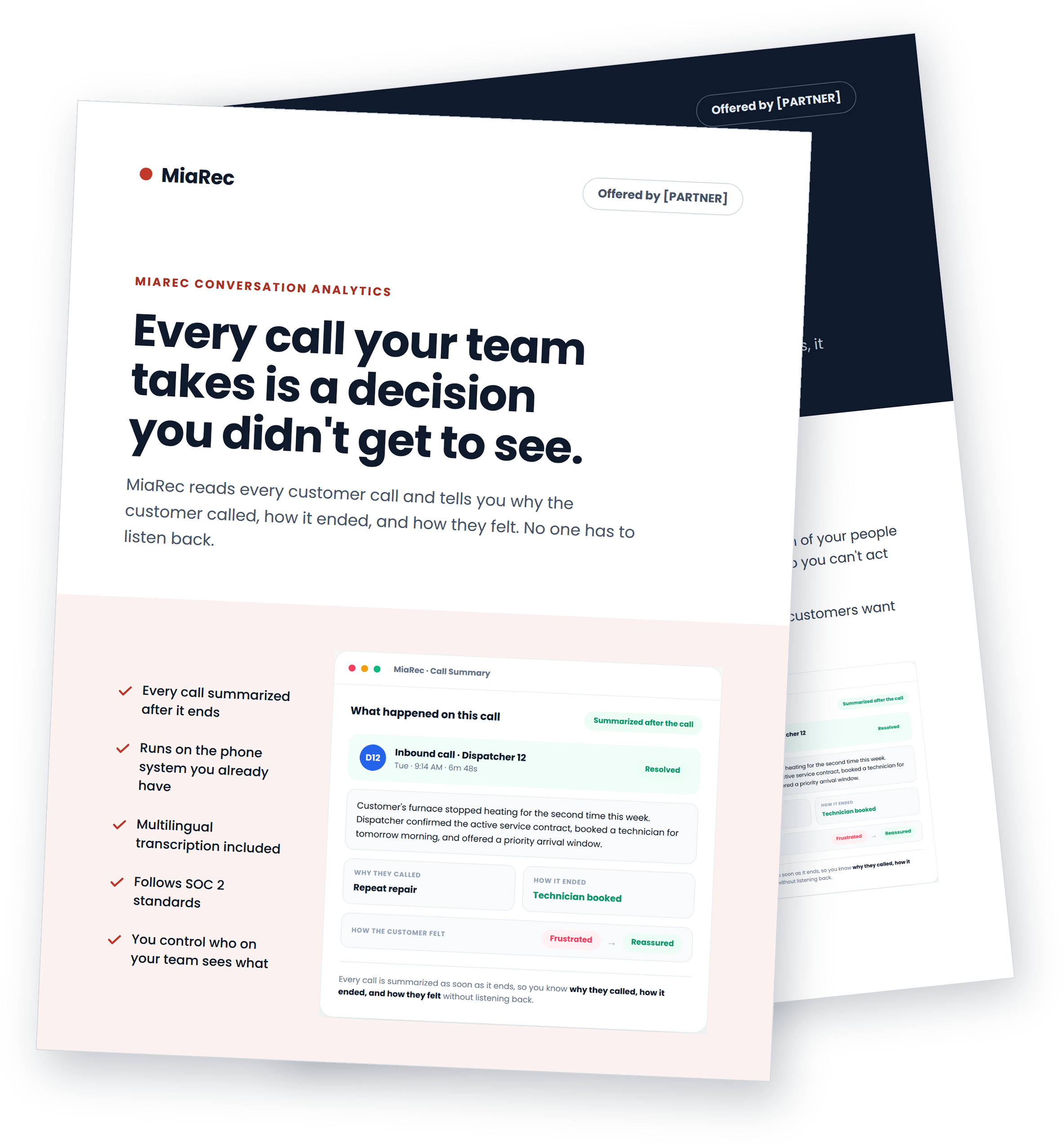
Customer email template
One email to send across your whole book of business. Attach the brochure or solution brief, and send it from a named account manager rather than a no-reply address.
Know what's happening on every customer call
New from [PARTNER]: AI for the calls your team already takes
Hi [First name],
Your best information is in your customer conversations: why people call, what frustrates them, and what they wish you offered. But nobody has time to listen to every call, so most of it never reaches you.
That's why we've added MiaRec Conversation Analytics to the services we offer. It runs on the phone service you already have with us. After each call, it writes a short summary of why the customer called, how the call ended, and how the customer felt. You can read your whole team's day in a few minutes, and over a few weeks you start to see the patterns: which issues keep coming up, which locations get the frustrated callers, and who on your team handles calls best.
You decide what the summaries capture, in plain English, so it reports back in the terms your business already uses. There's no new equipment to install and no AI expertise needed.
I've attached a short overview. If you'd like to see what it could do for your team, reply to this email and I'll set up a short demo.
[Signature]
Social posts
Most of the businesses I work with are phone-heavy businesses. They receive hundreds, if not thousands, of calls every day. All the important data is hidden in these customer conversations, but their managers have no scalable way to know what happened in each and every one of them.
This has massive implications for their ability to manage, and therefore for their bottom line. For example, they often find out a customer was unhappy when the customer leaves.
We now offer a way to change that. MiaRec Conversation Analytics reads every call your team takes and, once each one ends, tells you why the customer called, how it was resolved, and how they felt. You can read your whole team's day in a few minutes.
It runs on the phone service you already have with us, and it requires no AI expertise. If you've ever wished you knew what was being said on your calls, message me and I would be happy to show you how easy it is to get full visibility across all of your conversations.
A lot of the business leaders I work with are being asked, "What's our AI plan?" and don't know where to start.
If your business is largely phone-based, start with your calls. This is one of the highest-ROI use cases for AI right now. That's where customers tell you what they need and what's going wrong.
MiaRec Conversation Analytics summarizes every call, notes the reason and the outcome, and shows how the customer felt, with no new system to roll out.
Happy to show you how this could work for your business.
If you record your calls for compliance or training, here's a question: who actually listens to them?
For most teams, nobody has the time. Those recordings are full of useful information about why customers call, what keeps going wrong, and who on your team handles it best.
MiaRec Conversation Analytics reads every call and turns it into a summary you can scan in minutes. It sits on top of the phone service you already have. Ask me about it.
Sell: Use In One-on-One Conversations
-
Discovery questions: to uncover the right pain before you pitch
-
The 30-second and 90-second door openers: what to say when MiaRec comes up
-
Copy-paste lines: short openers for chat or a quick message
- Follow-up emails: three templates for the three conversations where MiaRec comes up most
Coming in Phase 2: co-branded versions of these assets, available on request.
Discovery questions that uncover the right pain
Start here. Ask a few of these before you pitch, so the door opener lands on a problem the customer has already named.
- How many calls does your team take in a typical week? How many of those do you personally listen to to know what is going on?
- When a customer leaves, how do you usually find out, and how long after the fact?
- How do you know what customers are calling about most right now?
- If a new hire is handling calls badly, how long before you'd know?
- Do you have locations or teams you're responsible for but can't be in the room with?
- Are you recording calls today? What do you do with the recordings?
- What would you want to know about your calls that you don't know now?
- What's the one thing you'd want every call summary to capture for your business?
The last question does two things: it shows the "shaped by your business" difference, and it gives you the example to use in the demo.
The 30-second door opener
You told me the business runs on the phone, but you don't get to hear the calls yourself. We now have a new AI product that listens to every call for you. When a call ends, it writes a short summary, notes why the customer called and how things were resolved, and tells you how the customer felt. You open one screen in the morning and see what happened across your whole team yesterday, without listening to a single recording. It runs on the phone system you already have with us, so you don't need to install anything new.
The 90-second door opener
You have hundreds, if not thousands, of calls a week going through your team, and you are responsible for all of them. The problem is that you don't have time to listen to any of them. So, you usually don't hear about a customer being unhappy until they cancel.
MiaRec Conversation Analytics sits on the phone lines you already have with us. As soon as a call ends, it transcribes and summarizes it. You see why the customer called, how the call ended, and how they felt from start to finish. You can read your team's day in a few minutes. Over a few weeks, the patterns start to show: which call reasons are increasing, which location gets the frustrated callers, who on your team is excellent, and who could use some coaching.
What makes it different from generic tools is that you set it up around your business. You tell it in plain English what a summary should capture, and you name the call reasons in your own words. So it reports back in the terms you already use, not someone else's template.
And it can grow with you. Once you're seeing your calls, you can add scoring for every call against your own quality standard. You can also have each call update your records and automatically create follow-ups.
The easiest way to decide is to see it for yourself. Worth scheduling a 15-min chat?
Copy-paste lines
For chat or a quick message.
Quick one: we now offer an AI layer on top of your phone service that reads every call and tells you what happened: why the customer called, how the call ended, and how they felt, without anyone listening. No AI knowledge or additional equipment required. Worth a 15-minute chat?
You mentioned you are frustrated that you have no visibility into what's happening inside your customer conversations or what your team says on calls. We have a new AI solution that solves this. Can I show you what that would look like? (Oh, and no AI expertise or additional equipment needed.)
Scenario-based follow-up emails
Most account managers already have regular conversations with their customers: account reviews, renewals, support escalations, and requests for new lines or locations. MiaRec comes up naturally in three of them, and each one gets its own follow-up email.
Angle 1: The customer is frustrated they can't see what happens on calls
Use this when: The customer complains about something that happened on the phone, and they only found out after the fact. That might be an angry customer who escalated, a bad online review, a lost job, or a new hire they aren't sure about. It often comes up in an account review, or when they call about something else and vent. You'll hear lines like "I have no idea what my people are telling customers" or "I only hear about problems when it's too late."
Seeing what happens on your team's calls
Hi [Name],
You mentioned it's hard to know what's happening on your team's calls until a problem lands on your desk. We just launched a new AI product that made me think of you.
MiaRec Conversation Analytics runs on the phone lines you already have with us. When each call ends, it writes a summary that covers why the customer called, how it was resolved, and how the customer felt. You'd read your whole team's day in a few minutes, and you'd see problems while they're still small.
You also decide what the summaries capture, in plain English. If every call should note the equipment model, the appointment date, or the account number, it will.
I've attached a one-pager. The easiest next step is a short demo, so you can see what it could show you about your own team.
[Signature]
Angle 2: The customer asks about AI
Use this when: The customer asks what you offer in AI, mentions their competitors are "doing AI," or says their leadership wants an AI plan and they don't know where to start. This is the most common opening right now, and most customers asking it don't have a specific problem in mind yet.
A practical place to start with AI
Hi [Name],
Following up on your question about AI. For a business that runs on the phone, the most useful place to start is usually the calls themselves. That's where your customers tell you what they need, what's going wrong, and whether they're happy.
MiaRec Conversation Analytics reads every call your team takes and summarizes it once the call ends. It tells you why the customer called, how it ended, and how they felt. It runs on the phone service you already have with us, so there's no new system to roll out and no new habit for your team to learn.
I've attached a one-pager. If it's useful, I can set up a short demo, and you'd have something concrete to show your leadership team instead of a plan.
[Signature]
Angle 3: The customer wants more from their phone system
Use this when: You're in a renewal, an upgrade, a move to a new phone platform, or a conversation about adding lines or locations. It also fits when a customer records calls for compliance or training, but admits nobody listens to the recordings. You'll hear things like "we're paying for all this, and I'm not sure we use half of it" or "we record everything, but no one has time to go through it."
Getting more out of the calls you already record
Hi [Name],
Since we spoke about your phone setup, one more idea. Your team is already having hundreds of conversations with customers every week, and right now most of what's said on those calls isn't being used.
MiaRec Conversation Analytics adds a layer on top of the service you already have with us. Every call is summarized when it ends, with the reason for the call, the outcome, and how the customer felt. Over a few weeks, you start seeing which issues keep coming up, which locations get the most frustrated callers, and which team members handle calls best.
I've attached a one-pager. Happy to set up a short demo so you can see what could be sitting in those recordings.
[Signature]